_edited.jpg)

Would You Wear Clothes Online?
- Tax Loupe
- Nov 20, 2021
- 7 min read

Updated: Jul 16, 2022
Fashion Industry has a message for you:
"Tipi Tipi Top, which look do you wan(t),
Now you can choose or make your own,
Change it, edit it as per your mood zone,
And look buoyant in every tone (style)"
GIF Source: DREST
But first, what is Meta-verse? A tough nut to crack...
With giant strides (good rate of progress), the past 2 years has transformed everything - "changes are taking place with a blink of an eye". We have seen and are seeing quantum leap, inter alia, especially in technology & innovation. And now we are heading towards meta (enhanced version) of the verse (fictional world) i.e. Meta-verse.
To give you an understanding of what meta-verse is, see the below clip from the movie Johnny English Strikes Again (lead role played by our favorite comedy character Mr. Bean).
What you have seen? By putting the VR headset, Mr. Johnny interacts with the environment and the objects of the place far from him in a more immersive & lively manner, thereby getting enriching and close to real (i.e. quasi-physical as he was able to open and close the door and touch other things) experience without any physical presence (had he not made the mistake in unlocking the walking system). If you want to see what happened next click here (enjoy and come back to read & interact further with this blog).
Remember, the meta-verse is not limited to the virtual world or virtual reality as shown in the above video. It's more than that because we would be able to communicate with others, buy and sell things, enter into spaces built by others or invite people to spaces we create (on the basis of mood or specific event or activity), feel like we are in the game or the movie, hangout with our friends or peers, officially work & meet, and represent ourselves via avatars customized by us - from their clothes to accessories to hairstyle and what not (we have not seen these things in Mr. Johnny's video). All of this by just sitting on our couch.
As we would be represented by our avatar (s) in the society of digital beings, we would want to make them look best, after all 'first impression is the last impression' is true for the virtual world too. This creates a billion (may be trillion) dollar opportunity for the $2.5 trillion fashion industry in the digital and virtual clothing space. Interestingly, this 'perfectly in-line' combination of meta-verse and virtual fashion lies in something common.
Turning the Pages Back...
Both the concepts have been mentioned in sci-fi novels. Meta-verse was (more specifically) discussed in Neal Stephenson's (American writer) sci-fi novel 'Snow Crash' published in 1992. However, the sci-fi novel 'Stand on Zanzibar' published in 1969 by John Brunner (British author) also then talked about the point that people would rely on avatars to represent themselves on video screens in the near future.


The concept of virtual clothing was discussed in the book 'The Emperor's Virtual Clothes' by Dinty W. Moore published in 1995.

Indeed, 'a book is the source of ideas'. It looks like 'the predictions of the 90s are turning to reality' now. What more of that time will come to life, only time will tell. But it is true that,
"Someone's imagination creates an idea, Someone's idea creates an opportunity, And someone's opportunity creates a new reality"
Deciphering Digital/ Virtual Clothing Space
"It's not about creating anymore,
It's about creating what customer wants,
It's more about, let customers create what they want"

Source: The Fabricant
Idea to reality: Attributable to which Space?
The first thing which comes to mind when we talk about virtual clothing is the gaming space. Many of you are or have been gamers (as of now, there are whopping 3.24 billion people who play video games across the globe). And must have created funky, snazzy (attractive) and classy look of game characters - ranging from caps to goggles to clothes to foot-wears (this is called 'skin' in the gaming world i.e. things which changes appearance of an item), everything which we felt proper and appealing.
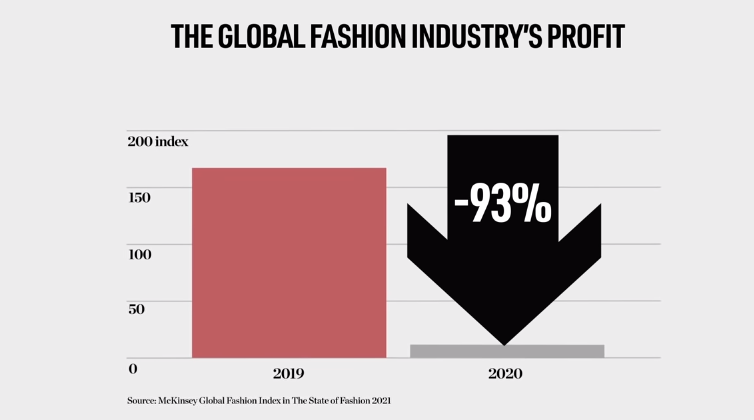
When the pandemic hit and lockdown happened, the buying of clothes came significantly down and sales dropped by 50.5% as of April 2020 (as we were not able to visit the stores and try on dresses) resulting in decline of profits for the global fashion industry roughly by 93% in 2020.
The other thing which happened during the lockdown is the acceleration in digitization and digital adoption (on global scale, the digital adoption accelerated by 3 years and 58% interactions of customers are now happening through digital channels). Though, we were not able to visit the stores but we were on internet, very active on social media platforms and playing games and were making purchases in the games. Many gamers actually spend real money to buy the skins in the game (the skins market is expected to reach $50 billion by 2022). Even, the in-game purchases were $54 billion in 2020 and is expected to reach $74 billion by 2025.
Seeing this purchase behavior and considering the fact that gaming is the most preferred entertainment form (standing at the 2nd position in the media sector with $160 billion in revenue across the globe in 2020), many fashion brands entered into partnerships with game development companies & started offering outfits and accessories which can be used in the games. For e.g. Gucci, an Italian luxury fashion house, created Virtual 25 Sneakers (soft shoes used for sports or casual wear) which can be used in the Roblox game and in virtual platform VR chat.

ROBLOX GAME


Source: dezeen.com (Gucci Virtual 25), WIRED (Roblox), and Business Insider (VR Chat)
Other Offerings Lit Up
The making & selling of digital outfits and accessories to be used in the games created other business pipelines and many brands started to offer:
Outfits & Accessories which can be used as filters on social media platforms. For e.g. the RTFKT, creator of virtual sneakers and other collectibles, made sneakers which can be used as Snapchat filter.
Source: lens.snapchat.com
Digital outfit bespoke fitting on photos & in videos. For e.g. Auroboros, a digital fashion startup, offers insertion of clothing digitally on a picture. Further, Gucci, has created an entire 'North Face Gucci Collection' for wearing in photos and videos using AR (augmented reality).

Virtual trial rooms where you can first try the dress digitally before visiting the store physically or ordering it online. For e.g. major brands like Adidas are working to provide virtual fitting room to consumers. Moreover, the virtual fitting room market is estimated to reach $10.57 billion by 2028 at 19.29% CAGR. One more way of virtual trial is placing a digital screen in the stores which puts the dress on the customer's body when they stand in front of it.

Physical copy of digital outfit. So, you buy the dress digitally and if you want you can also get its physical version.
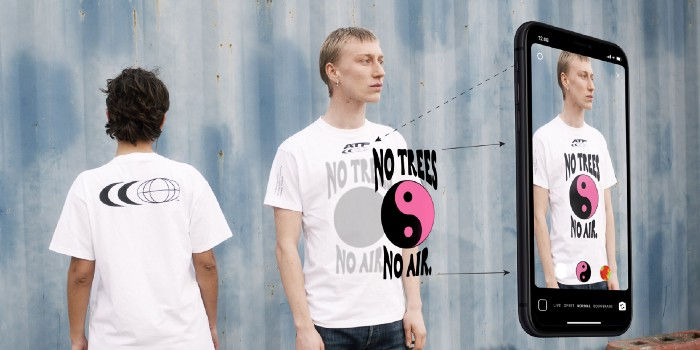
Collection of various designs which can be used on the same outfit through AR. For e.g. Scandinavian (region in north eastern part of Europe) retailer, Carlings, made T-shirt named 'Last Statement T-shirt' on which number of designs can be displayed.
Source: dezeen.com
Digital clothing for physical clothes. For e.g. HOT:SECOND, an English fashion company, is offering digital clothes to store visitors in exchange of discarded physical ones.
All these offerings are likely to soar with the meta-verse. If we can spend real money for the game characters, for bespoke fitting, on dress filters, and virtual designs, it is very likely that we would spend real money for our virtual self as well. Globally, people have already spent > $100 billion on virtual goods including digital fashion items. One more astonishing fact is that virtual fashion items are sold for the price more than that of physical items. For e.g. Gucci bag which can only be used in the meta-verse was sold for $4115. Also, the dress named 'Iridescence' made by the fabricant was sold for $9500. The meta-verse is expected to fuel the demand for digital clothes and accessories and could thereby provide a whole new growth trajectory for the fashion industry. It will open gates for new level of clothing and customer's fashion experiences. For e.g. may be our avatar wears a dress which displays different designs or messages all the time just like a digital billboard or a dress which plays music. Whoa! This is going to be interesting.
Benefits of Digital Clothing
Balanced Production: It focuses on creating things as per customers need and preferences and thus gives objectivity to the fashion. This not only enhances customers experience but help brands operate efficiently (by cutting the cost of material & labor for unnecessary production). For e.g. PUMA created a 'Day Zero Collection' in partnership with the Fabricant. This reduced their cost by 30%.
Environment Friendly and Sustainability Propagator: The cost of fashion to the environment is very huge. Every year, 92 million of textile waste is generated and only 12% of the material used is recycled. The fashion industry contributes to 10% of all the GHGs emissions and responsible for 20% of global waste water. All these can be reduced to a large extent by the digital fashion. The production of digital garment emits up to 97% less CO2. Moreover, it also saves cost of fuel & time associated with delivering physical outfits for both the company and customer. Customers have realized the ill effects of fast fashion on the environment and nearly 50% fast fashion retailers have reported decline in purchases. Digital fashion is a good substitute for fast fashion.
More Inclusive and provides endless opportunity for innovation & creativity: There is no worry of size or gender in digital fashion. Further, it provides number of options to choose from and thus offers newer personality experiences to the customer. It acts as a platform for designers and fashion experts to express their imagination more openly.
Re-sale market just like skin betting: In the gaming world, skin betting refers to the practice of selling and buying skins which gamers earned or purchased in the game. On the similar lines, people would be able to sell the digital dress and accessories online to others and earn money out of it. For e.g. Decentraland platform enable users to make and sell digital clothing on the blockchain in the form of Non-fungible Token (NFT). The sales of the platform for the first half of 2021 stand at $7,50,000.
Reduce return (give back) rates: The concept of digital try-on before actual purchase has reduced the return rate by 36%. This prevents wastage of resources.
We are resting our 'digital pen' here and would like to ask you - Do you see any problems with the digital clothing? What future developments will take place in this space according to you? What differences do you see between 'physical beings society' and 'digital beings society' in terms of fashion? Are you willing to pay for digital outfits?
Don't stop yourself from expressing your views, said the comment section.
If you found this insightful, do not forget to fill the subscriber form and follow us on LinkedIn.



Insightful!