_edited.jpg)

SEBI is Digging a New Pond for Bonds
- Tax Loupe
- Jul 23, 2022
- 2 min read


SEBI’s is digging a new pond for regulating online bond platforms. What’s SEBI’s move? Why SEBI is doing this? How it will do it?
As of 2021, India’s bond market stood at $2 trillion.
Majorly it includes Central Government Securities, State Development Loans and Corporate Bonds.
Mainly, institutional investors like pension funds, mutual funds and insurance companies participate in bond markets. Why?
There are two types of bonds issue – one is public (anyone can subscribe the bond in the issue) and other is private (only select persons can subscribe). In which type issues are higher?

Source: SEBI
Why private placement is preferred?
1. Low interest rates
2. Less regulatory requirements
3. Low cost of issue
4. Quick completion of issue
For participation in privately placed bonds, the SEBI created a platform known as Electronic Book Provider (EBP) Platform. EBP has been introduced for fair price discovery and transparency. It helps in facilitating the private issues as stock exchange mechanism does in case of public issue.
EBP platform is for Qualified Institutional Buyers (QIBs which includes mutual funds, pension funds, insurance companies, foreign funds, commercial banks, VC funds etc.) and for those non-QIBs which receive bond issuer’s permission (this is where the opportunity for making bond market accessible to non-QIBs/ non-institutional investors came in). EBP helps in bidding as well.
Seeing this, many platforms have emerged which provide online access to non-institutional investors (NIIs i.e., individuals, NRIs, companies, trusts etc.) to the bond market and these platforms and investor participation (mainly NIIs) through them is continuously rising.

Source: SEBI

Source: SEBI
The number of investors and volume of trade has got SEBI’s attention and it has proposed a framework (new pond) to regulate online platforms.
Why people are interested in online bond platforms?
Lower fixed deposit rates
High interest rate on bonds.
Variety of bonds offered by online platforms (attached below is the screenshot of GoldenPi bonds offering taken from their website).

4. The easy access provided by the online platforms – same as buying groceries or clothes online.
What are SEBI’s concerns?
Lack of regulation.
Improper display of listed and unlisted bonds.
Platforms do not follow KYC norms as per Prevention of Money Laundering Act.
No information on how investor grievances are resolved.
The investor protection provided by stock exchange is not available to investors doing investment through these platforms.
Proper disclosures of credit ratings and other important information (like yields).
Platforms might be engaged with issuer and having interest in it. This increases the scope of regulation as huge public money is involved.
Platforms are selling bonds on private placement basis to more than 200 investors (200 is the upper cap in case of private issue and if bonds are issued beyond 200 investors, it is deemed as public issue and public issue requirements would require to be complied with).
Reporting of transactions by the online platforms.
Improper clearing & settlement system.
What SEBI is planning to do?
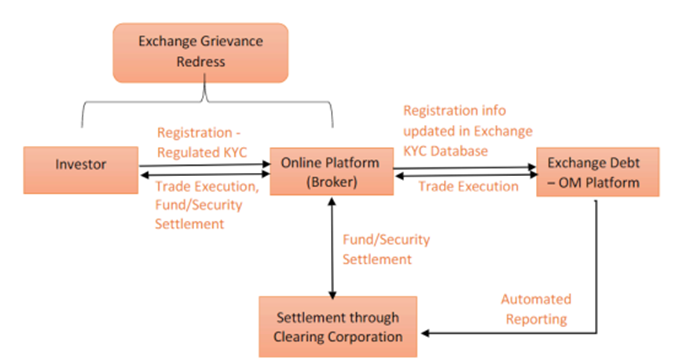
Platforms would be required to register as stock brokers as they are essentially facilitating transactions (this will lead to compliance with KYC norms, minimum net worth requirements, code of conduct for stock brokers and regulatory oversight).
Only listed securities would be allowed to be offered via platforms.
To address the gap of deemed public issue, securities would be locked in for 6 months.
Transactions via stock exchange debt segment platform (this will lead to fair pricing, resolution of investor grievances, proper settlement).
This is how SEBI’s proposal would change the transaction channel:
Source: SEBI



Comments